


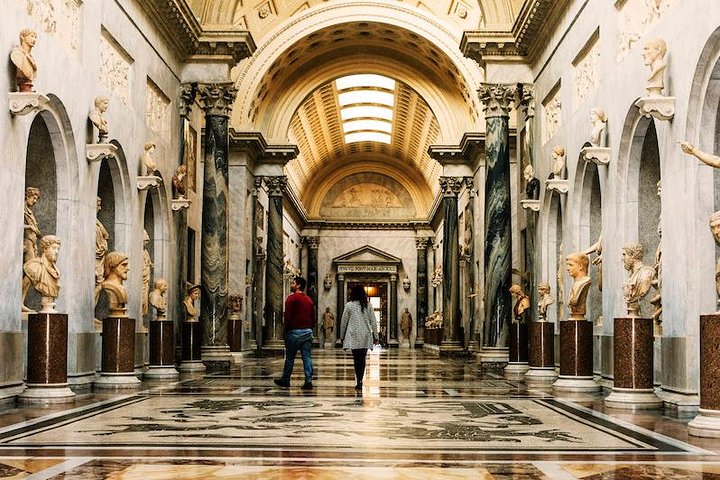


The Vatican Without the Crowds
A private Vatican tour dedicates a guide exclusively to your group — the pace, the focus, the depth of narration, and the route through the museums are entirely customised. The Vatican Museums contain approximately 70,000 works of art across 54 galleries, and the standard group tour covers a fraction of this collection in a fixed sequence (the Gallery of Maps, the Gallery of Tapestries, the Raphael Rooms, the Sistine Chapel, then St Peter’s Basilica). A private guide selects the route based on your interests — spending 30 minutes in the Raphael Rooms if your group is art-focused, or 30 minutes in the Egyptian Museum if your group is history-focused, and adjusting the pace to the energy of the group rather than the schedule of a fixed departure.
The private format is particularly valuable at the Vatican because the museums are crowded (6–7 million visitors annually, concentrated in the same corridor sequence), and a private guide manages the crowd dynamics — timing the entry to avoid the worst congestion, selecting the gallery sequence that puts you ahead of the group-tour traffic, and positioning you in the Sistine Chapel at the viewpoints where Michelangelo’s ceiling is most legible without the press of other visitors.
The Sistine Chapel narration must happen before you enter (talking inside the chapel is prohibited — guards enforce silence). A private guide provides this narration in a quieter gallery beforehand, using a tablet or printed images to explain the ceiling’s theological programme, the composition of The Last Judgment, and the specific panels and figures to look for when you enter the chapel. This preparation transforms the Sistine Chapel experience — you enter knowing what you are seeing rather than looking up at a confusing (if spectacular) visual overload.
St Peter’s Basilica on a private tour allows the guide to cover the building’s architectural and artistic significance in detail — Michelangelo’s Pietà (behind glass since 1972, after a hammer attack), Bernini’s baldachin (the 29-metre bronze canopy over the papal altar, cast from bronze stripped from the Pantheon’s portico), the Dome (designed by Michelangelo, completed after his death), and the Vatican Grottoes (the tomb of St Peter, beneath the basilica, accessible via a staircase from the nave).
What a Private Tour Covers
The Vatican Museums — the Pio-Clementino Museum (classical sculpture — the Laocoön, the Apollo Belvedere), the Gallery of Maps (40 topographical maps of Italy painted on the walls and ceiling of a 120-metre gallery), the Gallery of Tapestries, the Gallery of the Candelabra, and the Raphael Rooms (Raphael’s frescoes, including The School of Athens — the most famous image of the Renaissance after the Sistine Chapel ceiling).
The Sistine Chapel — Michelangelo’s ceiling (painted 1508–1512, covering approximately 500 square metres with scenes from Genesis — the Creation of Adam is the centrepiece) and The Last Judgment (the altar wall, painted 1536–1541, depicting the Second Coming of Christ in a composition of extraordinary power and drama).
St Peter’s Basilica — the largest church in the world (covering approximately 23,000 square metres), the spiritual centre of the Roman Catholic Church, and the culmination of the Vatican visit. The basilica is free to enter (no ticket required) but the guide’s narration transforms a walk through an enormous church into an encounter with 2,000 years of Christian history and some of the finest art and architecture ever created.
Frequently Asked Questions
How much does a private Vatican tour cost?
Private guide fees range from approximately €200–500 for a 3-hour Vatican tour, plus the skip-the-line museum entry tickets for each participant (approximately €25–35 per person). The guide fee is per tour, not per person — groups of 4+ achieve good per-person value.
How long is a private Vatican tour?
Typically 3–4 hours for the museums, the Sistine Chapel, and St Peter’s Basilica. Extended private tours (5–6 hours) add the Vatican Gardens, the Dome climb, or the Grottoes.
Is a private tour worth the extra cost?
At the Vatican — more than almost any other major attraction — yes. The crowds are intense, the collection is vast, and the guide’s ability to manage the route, the timing, and the narration in a personalised format transforms the visit. The alternative is a group of 20–30 people following a guide with a numbered sign through corridors packed with thousands of other visitors. The private format is a fundamentally different experience.
Can a private guide help me avoid the crowds?
A private guide manages the timing (early morning or late afternoon entry reduces congestion), selects the route sequence to stay ahead of the group-tour traffic, and positions you at the key works (the Laocoön, the School of Athens, the Sistine Chapel viewpoints) at the moments of least congestion. The crowds do not disappear, but the guide’s management makes them significantly less oppressive.