


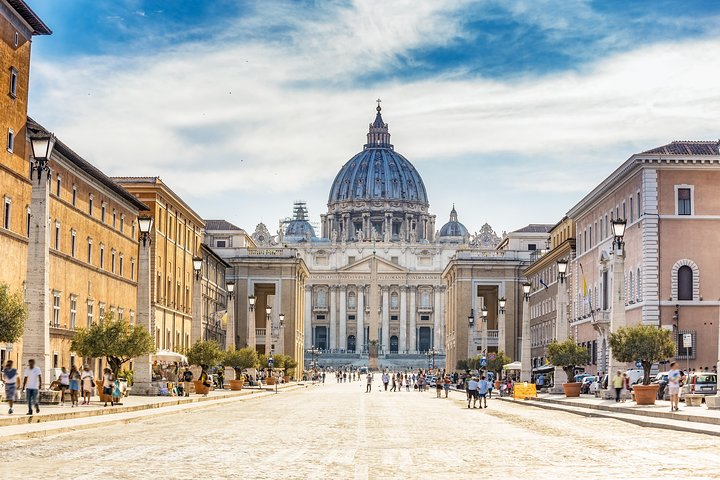


Why You Need a Guide at the Vatican
The Vatican Museums are not a self-explanatory experience. The 54 galleries contain 70,000+ works spanning 5,000 years of art history — from Egyptian sarcophagi to Renaissance masterpieces to contemporary installations — and the sequence in which you encounter them, the significance of what you are seeing, and the connections between the works are invisible without a guide. A guided Vatican tour provides the narrative framework that transforms a walk through crowded corridors into a comprehensible encounter with Western civilisation’s artistic and religious heritage.
The Sistine Chapel is the critical example. Without narration, you enter a crowded room, look up at a ceiling covered in painted figures, take a photograph (prohibited but universally done), and leave. With a guide’s pre-chapel briefing, you enter knowing the theological programme (the nine scenes from Genesis, arranged from the Creation to the Drunkenness of Noah), you can identify the specific panels (the Creation of Adam — the hands almost touching — is in the centre), you understand The Last Judgment’s composition (Christ at the centre, the saved rising on the left, the damned falling on the right, with Michelangelo’s self-portrait hidden in the flayed skin held by St Bartholomew), and the experience shifts from visual spectacle to intellectual and emotional engagement.
The Raphael Rooms are the second example. The School of Athens (Raphael’s fresco in the Stanza della Segnatura) is the most reproduced image of the Renaissance — Plato and Aristotle at the centre, surrounded by the great thinkers of antiquity. Without a guide, it is a beautiful painting of people in robes. With a guide, you identify the figures (Plato with the face of Leonardo da Vinci, Heraclitus with the face of Michelangelo — a tribute from one master to another), the philosophical argument encoded in the composition (Plato pointing up to the ideal, Aristotle gesturing down to the empirical), and the room’s function (it was Julius II’s private library — the frescoes represent the four branches of knowledge: theology, philosophy, poetry, and law).
A guided tour covers the Vatican Museums, the Sistine Chapel, and St Peter’s Basilica in approximately 3 hours, with the guide managing the route, the timing (avoiding the worst congestion), and the narration at each key work.
Frequently Asked Questions
How long is a guided Vatican tour?
Typically 3–3.5 hours covering the museums, the Sistine Chapel, and St Peter’s Basilica. Extended tours (4–5 hours) add the Raphael Rooms in depth, the Pinacoteca (painting gallery), or the Dome climb.
Is a guided tour worth it, or can I explore independently?
At the Vatican, a guided tour is worth it more than at almost any other museum. The collection is vast, the crowd management is essential, and the Sistine Chapel and Raphael Rooms are intellectually dense — the guide makes them comprehensible. Independent visitors with strong art-history knowledge can navigate effectively with an audio guide. For everyone else, a live guide is the recommended format.
What is the best guided Vatican tour?
The differentiator is the guide quality, not the operator. The best guided tours have knowledgeable guides (ideally with art-history credentials), small group sizes (8–15), skip-the-line entry, and the pre-Sistine-Chapel briefing that makes the ceiling legible. Read the reviews for the guide’s name — the best guides are consistently mentioned by name.
Do guided tours include St Peter’s Basilica?
Most do — the standard route exits the Sistine Chapel through a door that leads directly into St Peter’s Basilica (bypassing the basilica’s own queue). The guide covers the basilica’s highlights (the Pietà, the baldachin, the Dome, the Grottoes entrance) as the tour’s conclusion.